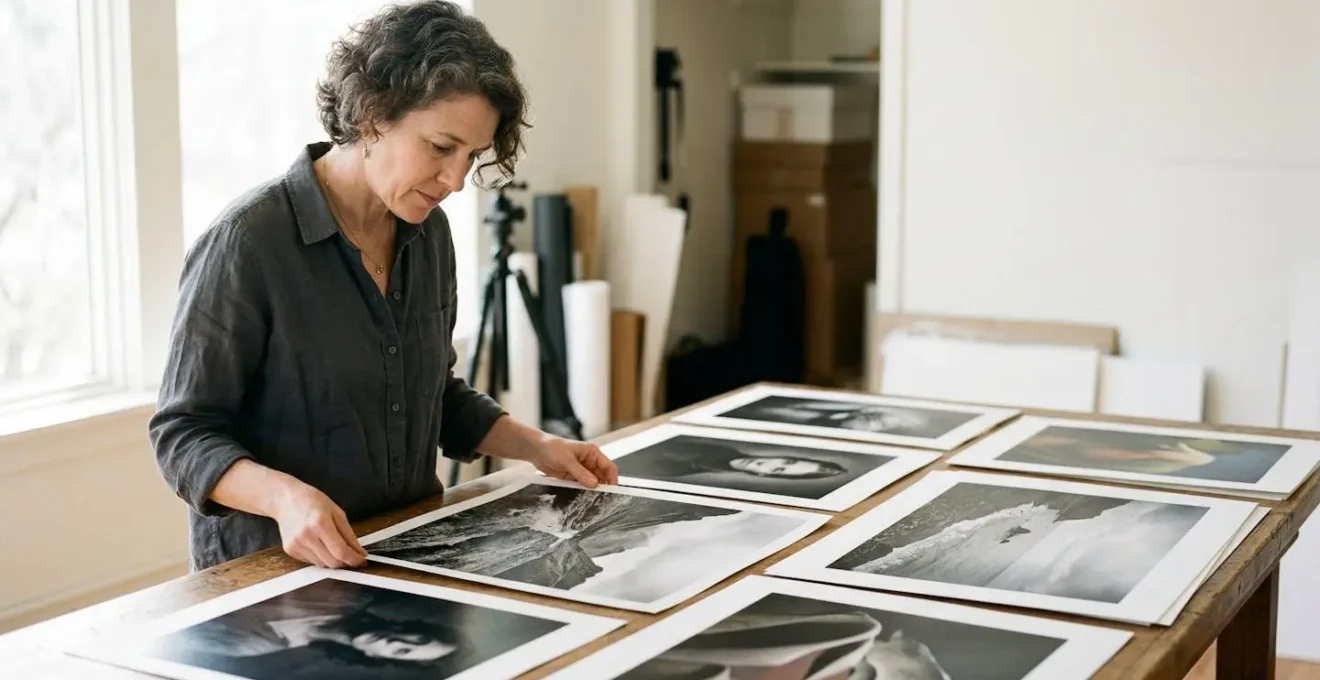
Your first solo exhibition is not just a party; it is the strategic launch of your artistic brand and a critical career milestone.
- Success depends on treating the show as a planned business event, focusing on visual storytelling, commercial strategy, and targeted promotion.
- Every choice, from the venue and framing to lighting and curation, must work together to build a coherent and compelling narrative for collectors and critics.
Recommendation: Shift your mindset from simply ‘displaying photos’ to orchestrating a memorable experience that establishes your credibility and drives your career forward.
For every emerging photographer, the dream of a first solo exhibition represents a monumental milestone. It’s a moment of validation, a public declaration of your artistic voice. But in the excitement, many artists focus solely on the logistics: printing, framing, and sending out invitations. The common advice revolves around creating checklists and choosing your “best” work. While essential, this approach misses the fundamental point. An exhibition is far more than a collection of images on a wall.
What if the true key to a successful show wasn’t just in the quality of the photos, but in the strategic architecture of the entire event? Think of your first solo show not as a retrospective of your past work, but as the business launch for your future career. It’s an opportunity to control your narrative, engage with collectors, and build the credibility that will sustain you for years to come. This perspective transforms every decision—from the choice of a gallery to the angle of a light—into a strategic tool.
This guide moves beyond the basics to provide the logistical and strategic framework of a professional gallery event planner. We will deconstruct the process, focusing on the critical decisions that turn an art show into a career-defining moment, from choreographing the viewer’s journey to securing the media coverage that ensures your work is seen and celebrated.
To help you navigate this pivotal event, this guide is structured around the key strategic questions you’ll face. The following summary outlines the path we will take, from foundational choices about your venue to the long-term vision for your artistic career.
Summary: A Strategic Roadmap for Your First Solo Exhibition
- Pop-Up Space or Established Gallery: Which Builds More Credibility?
- How to Hang Your Show to Tell a Coherent Visual Story?
- Uniform Framing or Eclectic Mix: Which Sells Better?
- The Lighting Mistake That Leaves Your Best Piece in the Dark
- When to Contact the Press to Guarantee Coverage of Your Opening?
- Why Do You Need “Hero Images” to Anchor a Visual Narrative?
- The Curation Mistake That Exhausts the Viewer Before They Buy
- How to Navigate Art Fairs to Acquire Investment-Grade Photography?
Pop-Up Space or Established Gallery: Which Builds More Credibility?
The first major decision you’ll face is choosing the stage for your debut. The conventional wisdom often favors the prestige of an established gallery, assuming its white walls and history automatically confer legitimacy. While there is undeniable power in this association, it’s a mistake to dismiss the strategic advantages of a pop-up space. The choice isn’t between “good” and “bad,” but about what kind of credibility currency you want to build.
An established gallery offers a turnkey solution: a built-in audience of collectors, professional staff, and a reputation that you can leverage. However, this often comes with long waiting lists, high commissions, and less creative control. A pop-up, on the other hand, provides agility and direct access to a new audience. By transforming an unconventional venue—a retail space, a warehouse, a shipping container—you create an event with a sense of urgency and discovery. This approach can democratize the viewing experience, attracting press and public who might be intimidated by the traditional gallery scene.
Ultimately, a pop-up allows you to be the producer, director, and star of your own show. It demonstrates entrepreneurial spirit and a willingness to engage the community on your own terms, which can be just as valuable as the stamp of approval from a legacy institution.
Case Study: The Pop-Up as a Launchpad
Recent trends show that pop-up galleries are powerful tools for breaking down the exclusive barriers of the art world. By bringing creativity into everyday spaces, they cultivate a sense of mystery and curiosity that attracts a diverse audience of collectors and art lovers. More importantly, many successful temporary exhibitions have demonstrated their potential for lasting impact, eventually evolving into permanent cultural hubs and proving that a pop-up can be a powerful first step toward establishing a long-term presence.
How to Hang Your Show to Tell a Coherent Visual Story?
Once you’ve chosen your venue, the empty walls present a new challenge: how to arrange your work. This is not a simple act of hanging pictures; it’s an exercise in visual choreography. Your goal is to guide the viewer’s eye and mind through a carefully constructed narrative. A successful hang creates a rhythm, with moments of intensity, reflection, and connection. A poor hang feels like a cluttered portfolio review, overwhelming and confusing the audience.
The key is to think in terms of flow and pacing. Group images to create dialogue between them. Use a larger or more powerful piece to anchor a wall, and let smaller pieces respond to it. Most importantly, embrace negative space. The empty wall is not wasted space; it is an active element in your composition. It gives the artwork room to breathe and allows the viewer a moment to pause and absorb what they’ve just seen. A professional installer’s advice is invaluable here, as they understand how to create this visual journey.
As one professional with extensive experience in galleries notes, the temptation to show everything is a critical error:
Trying to include too much work in the exhibition. There’s nothing more off-putting for the spectator than to be overwhelmed by a cramped, overcrowded gallery where the artist has tried to put artwork on every available wall space. Leave some small wall spaces empty, and these will act as visual punctuation marks allowing the visitors eyes time to breath.
– Professional exhibition installer, Quora
This strategic use of space is what separates an amateur display from a professional, curated exhibition. It shows confidence in your work and respect for your audience.
As you can see in a professionally curated space, the interplay between the artworks and the empty wall is deliberate. The spacing creates a visual rhythm, preventing viewer fatigue and ensuring each photograph can be appreciated on its own terms while contributing to the whole.
Uniform Framing or Eclectic Mix: Which Sells Better?
Framing is not just a protective measure; it’s a critical part of your commercial narrative. The choice between uniform framing and an eclectic mix sends a powerful signal to potential buyers. Uniformity—using the same style, color, and size of frame for all pieces—creates a cohesive, polished, and branded look. It suggests the work is part of a singular, confident vision, which can make the entire collection feel more valuable and intentional. This approach is often favored in contemporary galleries as it minimizes distractions and puts the focus squarely on the photographs themselves.
An eclectic mix, on the other hand, can lend personality and a more bespoke feel to each individual piece. Using different frames can highlight the unique character of a photograph or create a warmer, more “collected” aesthetic. This can be effective in more intimate or less formal settings, but it carries a risk. If not done with expert care, it can look chaotic and unprofessional, undermining the perceived value of the work.
For a first solo show, uniformity is generally the safer and more powerful strategy. It establishes a strong brand identity and presents your work as a mature, cohesive body. To maximize sales, however, consider offering framing as a customizable add-on rather than a fixed element. This allows you to present the work in its purest form while giving collectors the flexibility to choose a frame that suits their own taste and decor, turning a logistical choice into a revenue opportunity.
- Offer Customization Tiers: Provide “Good, Better, Best” framing options (e.g., standard matting vs. museum glass) to appeal to different collector budgets and signal premium value.
- Leverage Visualizer Tools: Use digital mockups to show clients how their chosen photograph will look in different frame styles, increasing their confidence to purchase.
- Create Urgency: Implement a limited-time offer on a premium framing package for purchases made during the exhibition to encourage decisive action.
- Position Framing as a Service: By offering framing as a separate service, you can simplify your initial exhibition costs while creating an additional revenue stream and building customer loyalty.
The Lighting Mistake That Leaves Your Best Piece in the Dark
You can have the perfect venue, a masterful hang, and exquisite framing, but if the lighting is wrong, the soul of your work is lost. Lighting is not an afterthought; it is the element that directs attention, creates mood, and reveals the texture and detail in your prints. The most common mistake emerging artists make is settling for generic, flat overhead lighting, which can create glare and wash out the subtleties of their work.
Professional gallery lighting is a science. The goal is to illuminate the artwork without illuminating the wall or creating distracting reflections. According to lighting design professionals, the ideal way to achieve this is to position spotlights so they strike the artwork at a 30-degree angle. This angle minimizes both veiling reflections (glare) and the shadow cast by the frame. If you can’t control the fixtures, use barn doors or snoots to shape the light and focus it precisely on the artwork.
The color temperature of the light is equally critical. It dictates the atmosphere of the entire exhibition. A warm light can make a space feel intimate and traditional, while a cooler, neutral light provides a crisp, modern, and objective presentation. This decision should not be arbitrary; it must align with the emotional tone of your photography.
| Color Temperature | Kelvin Range | Best For | Atmosphere Created |
|---|---|---|---|
| Warm White | 2700K-3000K | Photography with subdued colors, vintage prints, black & white work | Cozy, intimate, traditional gallery feel |
| Neutral White | 3500K | Artwork with bright, vibrant colors, contemporary photography | Balanced, professional presentation |
| Cool White | 4000K | Modern exhibitions, minimalist spaces | Bright, airy, contemporary atmosphere |
| Daylight White | 5000K-6500K | Mimicking natural light, enhancing true colors in fine art prints | Natural, museum-quality illumination |
When to Contact the Press to Guarantee Coverage of Your Opening?
An exhibition without an audience is just a room full of pictures. Securing press coverage is essential to driving foot traffic, building buzz, and catching the eye of collectors and curators. But “contacting the press” is not a single action; it’s a phased campaign. The biggest mistake is waiting until the week of the opening to send out a mass email. By then, editors’ calendars are full, and your announcement becomes noise.
A strategic press outreach plan, or event architecture, begins weeks, if not months, in advance. It involves identifying the right journalists, bloggers, and influencers and providing them with a compelling story, not just an invitation. Your press kit should be ready to go, containing high-resolution images of your “hero” pieces, your artist statement, a bio, and a concise press release that highlights what makes your exhibition newsworthy. Is it the theme? The technique? Your personal story?
Think of your outreach in waves, moving from broad to hyper-local, and from traditional to digital, to create sustained interest.
- Wave 1 – Long-Lead Media (4-6 weeks out): Pitch to arts and culture editors at local newspapers and magazines. Contact photography teachers at local colleges and universities, inviting their classes for a private viewing or talk.
- Wave 2 – Niche Digital Press (3-4 weeks out): Identify and pitch to specialized art bloggers, lifestyle journalists, and online publications whose audiences align with your ideal collector profile.
- Wave 3 – Broad Digital Amplification (1-2 weeks out): Leverage your own social media channels (Instagram, Facebook), online photography communities, and your website to build excitement and reach a wider digital audience.
- Wave 4 – Hyper-Local Presence (The week of): Place posters and flyers in local camera shops, photo labs, art supply stores, and community cafes to ensure visibility within your immediate creative and geographic community.
Why Do You Need “Hero Images” to Anchor a Visual Narrative?
Within your cohesive body of work, a few select images must do the heavy lifting. These are your “hero images.” They are the anchors of your visual narrative—the most compelling, memorable, and representative photographs in the exhibition. These are not necessarily your personal favorites, but the ones with the most stopping power. They are the images that will grace your invitation, lead your press kit, and serve as the unforgettable centerpiece of your show.
Identifying your hero images requires a degree of objective, ruthless editing. They must encapsulate the core theme and emotional tone of the entire exhibition in a single frame. A successful solo show often features a recommended 15-30 individual pieces, and within that collection, 1-3 hero images are essential. They provide a focal point for the viewer and a powerful marketing tool for you. They give journalists a story to latch onto and collectors an iconic piece to covet.
The selection process for these images should be deliberate. Don’t rely solely on your own judgment; you are too close to the work. Getting outside perspective is key to understanding which images resonate most strongly with an audience.
Case Study: A Deliberate Process for Finding Hero Images
For a large exhibition featuring 65 images from 25 photographers, organizers needed a strategic way to identify the strongest work. They sent thumbnails to volunteers, asking them to select one standout image per artist. A dedicated working group then made the final selection not from screens, but from physical 6×4-inch prints. This tactile process of arranging and rearranging the small prints allowed them to see which images had the visual power to anchor the narrative and serve as the cornerstone pieces for all promotional materials, ensuring the final hanging plan was built around the most impactful work.
Your hero images are the foundation of your exhibition’s story. They are the first chapter and the last word, pulling the viewer in and leaving a lasting impression long after they’ve left the gallery.
The Curation Mistake That Exhausts the Viewer Before They Buy
The single most common and fatal mistake in a first solo show is a lack of curatorial discipline. It’s the desire to show everything, to prove your range and productivity. This impulse, while understandable, leads to overcrowded walls, a confusing narrative, and, most importantly, viewer fatigue. A potential collector who is exhausted or overwhelmed is a collector who will not buy. Curation is the art of subtraction. It’s having the courage to leave out a good photo to make a great photo shine even brighter.
This discipline extends to the physical installation. As one experienced curator with over 150 installations to their name points out, even the best artists often don’t know how to hang their own work. There is a science to it.
Installing an exhibition is a specialty and, in my experience, even the finest artists have no idea how to do it! The centre of the work is 150–160 cm from the ground, with 155 cm as the ideal. Always hang works that are in series from the centre, and not from the top or the bottom of the frame.
– Exhibition curator, Quora
Adhering to a consistent eye-level centerline (around 155 cm or 60 inches) creates a harmonious visual plane that is comfortable for the viewer to scan. When you deviate from this, you force the viewer’s gaze to jump around, which is physically and mentally tiring. Your exhibition should feel like a graceful, flowing conversation, not a chaotic argument. The goal is to edit your collection down to its strongest, most essential components, and then present them with the precision and respect they deserve.
Your Exhibition Readiness Audit: Key Points to Verify
- Points of Contact: Inventory all channels where your artistic brand is communicated (e.g., your website, social media profiles, and artist statement) to ensure they tell a consistent story.
- Collection: Gather the entire body of work you are considering for the show, including recent series, key prints, and potential hero images, for a comprehensive review.
- Coherence: Confront this collection with your core artistic values and the exhibition’s central theme. Does every single piece actively support the narrative you aim to tell?
- Memorability & Emotion: Objectively identify the unique ‘hero images’ versus the supporting pieces. Map the emotional journey you want to guide the viewer through from start to finish.
- Integration Plan: Finalize the selection and sequence of works. Identify any gaps in the visual story and create a detailed hanging plan that prioritizes flow and impact.
Key Takeaways
- Treat Your Show as a Business Launch: Shift your focus from just displaying art to orchestrating a strategic event that builds your brand and engages collectors.
- Curation is Subtraction: The strength of your exhibition lies in what you choose to leave out. A disciplined, cohesive selection is more powerful than a crowded, comprehensive one.
- Control the Experience: Every detail—from the hanging height and lighting angle to the choice of frame—is a tool for choreographing the viewer’s journey and shaping their perception of your work.
How to Navigate Art Fairs to Acquire Investment-Grade Photography?
Your first solo show is a launchpad, not a destination. To build a sustainable career, you must understand the world your collectors inhabit. For many, that world includes art fairs. While the title of this section might seem geared towards buyers, your role is to reverse-engineer their mindset. By understanding how collectors navigate these bustling environments to find investment-grade work, you can better position your own photography to meet their criteria.
Collectors at art fairs are looking for three things: quality, coherence, and confidence. They are drawn to artists who have a clear, consistent vision and a professional presentation. This is where the lessons from your solo show become your blueprint for the market. A gallerist at a fair has mere seconds to assess your work. They need to see a portfolio—whether physical or digital—that is tightly curated, an artist statement that is concise and compelling, and an online presence that reinforces your brand.
Networking at these events is not about making a sale on the spot; it’s about building relationships. It’s your opportunity to learn what galleries are looking for and demonstrate your professionalism. The following steps are a roadmap for an emerging artist looking to make an impression:
- Build Your Foundation: Prepare a portable portfolio (a high-quality print book or a memory stick) and a polished, one-page artist statement. Gallery owners are busy but will always read a good statement.
- Attend Strategically: Visit art fairs and gallery openings not just to be seen, but to see. Analyze which galleries represent work similar to yours and observe how they present it.
- Establish a Digital Presence: Maintain a clean, professional online portfolio with only your best work. Be active on relevant social media platforms to showcase your process and engage with a wider community.
- Understand Consignment Models: Familiarize yourself with how galleries work. Most operate on a consignment basis, taking a commission (typically 50%) only when a piece sells. Understanding this reduces the perceived risk for a gallery to take you on.
- Practice Persistence: Rejection is part of the process. The art world is competitive, but persistence, combined with a consistently high-quality and coherent body of work, is what will set you apart.
As you submit your work for consideration, make sure you keep a consistent theme throughout your photos, and that it also coincides with your artist statement. Don’t just throw in a bad picture just because it fits, make sure you’re presenting only your best work, and keep it organized. Remember that persistence is important. It is a quality that will set you apart in a sea of talented photographers.
– Gallery submission experts, SLR Lounge
By applying this strategic, business-minded approach, your first solo exhibition will be more than a celebration—it will be the powerful, professional launch your artistic career deserves. Start today by shifting your perspective and planning not just a show, but a defining moment.