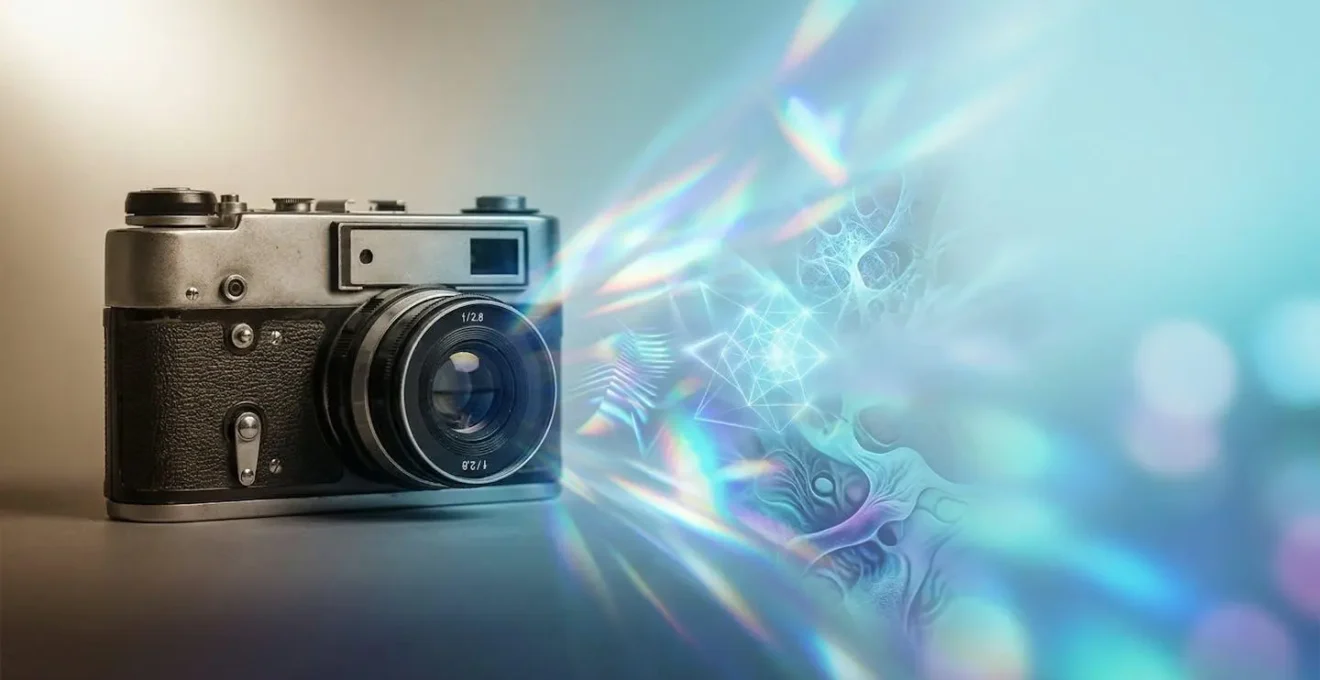
The future value of fine art photography will not be determined by technology itself, but by how artists and investors leverage it to redefine authenticity, scarcity, and experience.
- Algorithmic collaboration with AI is becoming a new form of artistry, but the market will place an “authenticity premium” on verifiable human intent and craft.
- Digital provenance via mature NFT ecosystems is solving ownership for digital-native works, while experiential consumption (VR/AR) is creating new markets alongside the timeless value of the physical print.
Recommendation: Shift focus from investing in technological gimmicks to building a portfolio that strategically balances digital innovation with tangible, story-driven works that have undeniable human authorship.
For artists and investors navigating the turbulent waters of the art market, the horizon seems crowded with disruptive technologies. The conversation is dominated by binaries: AI versus human creativity, NFTs versus the gallery system, virtual exhibitions versus the printed object. This framework, however, is a strategic dead end. It presumes a zero-sum game where one must win and the other must lose, forcing a choice between a romanticized past and an uncertain, digitized future.
This reactive stance misses the fundamental shift occurring beneath the surface. The true evolution of fine art photography is not a battle of mediums, but a profound recalibration of what constitutes value. The core questions are no longer just about aesthetics, but about provenance, experience, and authorship in a world of infinite reproducibility. The most successful artists and collectors of the next decade will not be those who pick a side, but those who master the new language of a hybrid ecosystem.
This analysis moves beyond the hype to dissect the underlying economic and cultural currents. We will explore how AI is becoming a collaborator rather than a replacement, how blockchain is maturing into a serious tool for digital provenance, and how the very act of consuming art is branching into parallel streams of physical and virtual experience. By understanding these tectonic shifts, we can build a forward-looking strategy that anticipates where true, sustainable value will accumulate over the next ten years.
To navigate this evolving landscape, this article provides a strategic overview of the key transformations shaping the future of fine art photography. The following sections break down the most critical trends, challenges, and opportunities for both creators and collectors.
Summary: Navigating the New Trajectory of Fine Art Photography
- Will AI-Generated Imagery Replace or Enhance Photography?
- How Are NFTs Solving the Provenance Problem for Digital Art?
- VR Exhibitions or Print on Wall: How Will We Consume Art in 2035?
- The “Gimmick” Mistake: Investing in Tech Demos Instead of Art
- How Is the Rise of African and Asian Markets Shifting the Canon?
- The Return of Analog: Nostalgia or True Market Value Increase?
- When to Release Provocative Art: Navigating Public Reception Safely
- Fine Art vs. Commercial: Which Approach Defines Your Career Path?
Will AI-Generated Imagery Replace or Enhance Photography?
The conversation around Artificial Intelligence in the art world is often framed as an existential threat to photographers. This perspective, however, overlooks the more nuanced reality: AI is not a replacement for photography but a powerful, and at times unpredictable, collaborator. The rise of AI tools marks a shift from capturing reality to synthesizing it, creating a new category of image-making. The economic momentum is undeniable; the AI image generator market is projected to surge from $8.7 billion in 2024 to $60.8 billion by 2030. This isn’t a niche trend; it’s a foundational economic and creative shift.
For the discerning artist and investor, this creates a crucial dynamic: the emergence of an authenticity premium. As the volume of synthetic imagery explodes, the value of work demonstrating clear human intent, a unique perspective, and tangible craft will escalate. The artist’s “gaze” and “sensitivity,” as photographer David Muñiz notes, become the differentiating factor that technology cannot replicate. He argues, “no tool is ever going to be able to replace the human gaze and sensitivity that a photographer has.”
The strategic play is not to fear or dismiss AI, but to engage in algorithmic collaboration. This involves using AI to augment vision, generate novel concepts, or create textures impossible to capture in-camera. The future value lies in a hybrid practice where the artist’s hand remains visible, either in the conceptual framework of the prompt or in the post-production and physical manifestation of the final work. The market will learn to distinguish between a soulless AI generation and a thoughtful, AI-assisted work of art.
How Are NFTs Solving the Provenance Problem for Digital Art?
After the speculative frenzy of 2021, the NFT market has undergone a necessary and sobering correction. The narrative of instant wealth has faded, replaced by a more mature focus on the technology’s core utility: solving the long-standing problem of provenance for digital-native assets. For fine art photography created and existing in a digital space, this is a revolutionary development. It allows for a verifiable, transparent, and permanent record of ownership and authenticity—something that was previously impossible for an infinitely reproducible file.
While the overall market capitalization declined from a peak of $25 billion to $4.8 billion in early 2024, a crucial detail for investors is that blue-chip collections have maintained 40-60% of their peak valuations. This signals a flight to quality and the emergence of a sustainable market for curated, historically significant digital art. The value is no longer in the novelty of the token but in the quality of the underlying artwork and the strength of its digital provenance.
The next stage for NFTs may depend on how seamlessly they integrate into existing cultural ecosystems. For collectors and institutions, this focus is shifting away from novelty toward sustainability and curation—they are now considering how blockchain can complement, rather than outright replace, traditional systems of provenance and display.
– Shaila Gray, Center for Art Law – The Digital Fade: NFTs and the Future of Blockchain Art
For photographers, this means digital editions can now carry the same weight and investment-grade security as a limited-edition physical print. For investors, it means digital assets can be collected with confidence, knowing their history is immutable. The future of NFTs in fine art lies not in speculative flipping but in their role as the gold standard for authenticating the digital masterpieces of the 21st century. The focus is shifting from tech-first assets to art-first assets verified by technology.
VR Exhibitions or Print on Wall: How Will We Consume Art in 2035?
The future of art consumption is not a choice between a virtual reality headset and a gallery wall; it is the parallel development of both. The concept of experiential consumption is branching, creating distinct but equally valid ways to engage with photography. On one hand, the digital realm offers unprecedented access and immersion. The market for museum VR and AR software is expanding, and a recent survey found that 77% of people would use VR to visit cultural collections that are otherwise inaccessible. This opens up global audiences and allows for exhibitions that defy physical and financial constraints, turning a viewing into a navigable, interactive world.
This digital expansion, however, does not negate the power of the physical object. In fact, it amplifies it. As our lives become more screen-mediated, the pilgrimage to see a physical artwork—to experience its scale, texture, and presence in a real space—becomes a more profound and valuable act. The aura of the original print on a wall, the subtle interplay of light on its surface, and the quiet, contemplative environment of a gallery offer a sensory experience that VR cannot replicate. This is the enduring power of the tangible artifact.
For artists and investors, this duality is an opportunity, not a conflict. The winning strategy involves a two-pronged approach: leveraging virtual platforms to build a global audience and narrative around the work, while simultaneously positioning the physical prints as premium, investment-grade artifacts. The VR exhibition can serve as the expansive, accessible story, while the print on the wall is the definitive, scarce, and highly coveted conclusion to that story. In 2035, we won’t choose one; we will expect both.
The “Gimmick” Mistake: Investing in Tech Demos Instead of Art
In every era of technological disruption, a common pitfall emerges for both creators and collectors: the allure of the gimmick. This is the tendency to prioritize novel technology over artistic substance, leading to investments in flashy tech demos rather than enduring works of art. The early days of AI art and the NFT boom were rife with examples—works that were celebrated for being “the first” or for using a new tool, but which lacked conceptual depth, emotional resonance, or aesthetic sophistication. These assets often see a rapid decline in value once the novelty wears off.
An enduring work of art, regardless of the medium, is built on a foundation of strong conceptual storytelling, technical mastery, and a unique authorial voice. Technology should be a servant to this vision, not the main attraction. As noted by The Intentional Artist, “focusing on authenticity, storytelling, and craftsmanship, artists and photographers can carve out a place where their work remains undeniably valuable.” The right question for an investor is not “Is this made with the latest tech?” but “Does this work use technology to say something meaningful that couldn’t be said otherwise?”
Distinguishing between a gimmick and a genuine innovation requires a critical eye. A gimmick often feels like a one-line joke—clever once, but with no lasting impact. A true artistic innovation uses new tools to deepen or expand the possibilities of expression, creating a work that rewards repeated viewing and contemplation. The most successful artists of the coming decade will be those who integrate technology so seamlessly into their practice that the conversation shifts from the tool back to the art itself. For investors, the most profitable strategy will be to bet on these artists, not on the fleeting novelty of their software.
Action Plan: Auditing Your Artistic Strategy for the Next Decade
- Assess Your ‘Why’: Is your work driven by a core artistic vision, or by the desire to use a new tool? Define your central themes and intent before choosing your medium.
- Evaluate Tech’s Role: Does the technology (AI, VR, NFT) amplify your concept, or is it the entire concept? If removing the tech aspect makes the art fall apart, it may be a gimmick.
- Analyze Longevity: Will this work still be relevant in five or ten years, after the initial technological hype has faded? Focus on timeless themes of the human condition.
- Scrutinize the Craft: Beyond the technology, is the work aesthetically compelling? Assess its composition, color, texture, and overall execution as you would any traditional artwork.
- Define Your Market: Are you targeting tech enthusiasts or art collectors? A work with long-term value must be able to cross over from the niche tech world to the broader art market.
How Is the Rise of African and Asian Markets Shifting the Canon?
For centuries, the canon of “fine art photography” has been overwhelmingly dominated by Western artists and institutions. This paradigm is undergoing a historic and irreversible shift. The economic and cultural ascendancy of markets in Africa and Asia is not just creating new collectors; it is actively rewriting the history of the medium and challenging the long-held definitions of what constitutes significant work. This canon disruption is one of the most powerful and under-reported trends shaping the future of the global art market.
The economic data provides a clear picture of this power shift. The Asia-Pacific photography market is projected to grow from $13.20 billion to $19.52 billion by 2030, and the region already commands an estimated 35% of the global photography services market share. This economic might translates directly into cultural influence. New museums, galleries, art fairs, and a burgeoning class of major collectors are championing local artists, bringing their narratives to the global stage. Photographers from Nigeria, Ghana, China, and South Korea, among others, are gaining international acclaim, and their works are achieving record prices at auction.
For investors, this trend represents a massive opportunity to get ahead of the curve. The work of many seminal African and Asian photographers is still relatively undervalued compared to their Western counterparts, but this gap is closing rapidly. Building a collection that reflects this new, globalized canon is not just an ethical imperative; it is a shrewd long-term financial strategy. For artists, it means a broader, more diverse field of influences and opportunities. The future of fine art photography is not monolithic; it is a polyphonic conversation between cultures, and the most resonant voices may come from the places the old art world least expected.
The Return of Analog: Nostalgia or True Market Value Increase?
In an age of digital saturation and algorithmic perfection, the resurgence of analog photography appears to be a paradox. Is it mere nostalgia, or does it signal a genuine and sustainable market trend? The answer is the latter, and it is driven by the same force that elevates human-made art in the age of AI: the authenticity premium. Film photography, with its tangible negatives, chemical processes, and inherent imperfections, offers a powerful counter-narrative to the slick, often sterile, world of digital imagery.
This is not a Luddite rejection of technology but a sophisticated market reaction. As generative AI in photography is poised for a staggering 42% annual growth, the very qualities that make analog “difficult”—its slowness, its cost, its unpredictability—become markers of value. They represent verifiable human effort, time, and craft. Each film photograph is a unique physical artifact, a direct trace of light hitting a physical surface, which cannot be perfectly replicated. This inherent scarcity and materiality make it highly attractive to collectors seeking tangible assets in an increasingly ephemeral world.
Photographer Albert Mora captures this sentiment well, suggesting that traditional and new techniques can coexist: “Film photography’s unique aesthetic can complement digital advancements beautifully.” The smartest artists and investors are not choosing between analog and digital but are building a practice or collection that leverages the strengths of both. For example, an artist might shoot on film to achieve a specific texture and aura, then create a high-resolution digital scan to produce an NFT with perfect digital provenance. This hybrid approach creates a best-of-both-worlds asset: the tangible romance of analog combined with the verifiable security of the blockchain.
When to Release Provocative Art: Navigating Public Reception Safely
Creating provocative art that challenges conventions has always been a high-stakes endeavor. In the current media environment, those stakes are amplified exponentially. The digital world offers unprecedented reach but also brings the risk of instantaneous, context-free backlash. The challenge for the modern artist is not just to create challenging work, but to strategically manage its entry into a world overwhelmed by content and primed for outrage.
The context for this challenge is the sheer volume of imagery we now face. By some estimates, as many as 71% of images shared on social media by late 2024 were AI-generated. This deluge of synthetic content creates both a problem and an opportunity. The problem is that it is harder than ever to capture audience attention. The opportunity is that authentic, human-made, and conceptually rigorous work has a greater chance of standing out—if it can successfully navigate the initial wave of public reception.
Safely releasing provocative work requires a deliberate strategy that goes beyond simply uploading an image. It involves building a narrative and providing context *before* the work is widely seen. This can be achieved through preliminary artist statements, interviews, or a “slow reveal” to a core audience of supporters and critics who can help frame the conversation. It’s about inoculating the work with its intended meaning before it can be hijacked by misinterpretation. Furthermore, choosing the right platform is critical. A curated online gallery or a respected art publication provides a vastly different context than a chaotic social media feed. The goal is to control the initial encounter, ensuring the work is seen as a piece of fine art to be contemplated, not just another piece of controversial content to be reacted to.
Key Takeaways
- Value Is Shifting: The future of fine art photography is a recalibration of value, where human intent, authenticity, and physical craft gain a premium in a digital world.
- Hybrid Is the Future: The most successful strategies will not choose between analog and digital, or physical and virtual, but will integrate them to create assets with both tangible and digital value.
- Invest in Vision, Not Gimmicks: Long-term value resides in artists who use technology to serve a compelling vision, not in works that are merely demonstrations of a new tool.
Fine Art vs. Commercial: Which Approach Defines Your Career Path?
The historic divide between the “pure” vision of the fine artist and the client-driven work of the commercial photographer is becoming increasingly blurred. In the next decade, this binary will become largely obsolete. The rise of the personal brand, the creator economy, and new digital platforms has created a hybrid space where artists can build sustainable careers by applying a fine-art sensibility to commercial-style projects. The overall global photography services market is projected to grow robustly to $60.8 billion by 2032, and much of this growth is happening in this new, fluid middle ground.
As Allied Market Research notes, “individuals are now using professional photographic services to create personal brand images that can help them stand out and attract followers.” An artist today can be commissioned by a tech brand to create an art piece for a campaign, sell limited-edition prints directly to a global audience online, and simultaneously exhibit a related body of work in a traditional gallery. The path is no longer linear. Success is less about choosing a single lane—”fine art” or “commercial”—and more about building a diversified “artistic enterprise.”
This new model requires a shift in mindset. Artists must become strategists, managing their intellectual property across different markets. A single photograph can become a gallery print, a licensed image for a brand, a piece of a digital collection, and a key visual in their own marketing. For investors, this means evaluating an artist not just on their gallery sales, but on the strength and diversity of their entire brand ecosystem. The most resilient and valuable artistic careers of the future will not be defined by a single approach, but by the artist’s ability to masterfully navigate and monetize their unique vision across multiple platforms and contexts.
The evolution of fine art photography is not a passive event to be observed; it is an active territory being shaped by the decisions artists and investors make today. By embracing a strategy that balances technological innovation with the timeless value of human creativity, and by looking beyond traditional Western markets, it is possible to not only navigate this new landscape but to lead it. The next step is to translate this understanding into a decisive and forward-thinking action plan for your art or your portfolio.