A collection’s cultural immortality is secured not by the quality of its images, but by the robustness of its legal and administrative framework.
- The historical value of a photograph is inextricably linked to its documented provenance—the “paper trail” is paramount.
- Strategic decisions regarding donation structure (private foundation vs. museum gift) and digital asset management are critical for preserving the collection’s integrity and accessibility.
Recommendation: Prioritize the creation of a comprehensive legal and archival strategy long before considering the final disposition of your collection.
For the serious collector, amassing a significant body of photographic work is a pursuit of passion, a lifetime dedicated to curating a vision. The thrill lies in the acquisition, the discovery, and the personal connection to each print. Yet, a critical question eventually surfaces, one that transcends personal enjoyment and touches upon the very essence of legacy: What becomes of this collection after I am gone? Many collectors assume that the artistic merit of the works alone will guarantee their place in history, destined for a museum wall. This is a profound and costly misunderstanding.
The common advice—to simply “keep prints in good condition” or “get an appraisal”—dangerously overlooks the complex machinery required to transition a private holding into a public cultural asset. Without a deliberate, legally sound structure, even the most important collections risk being dismantled, devalued, or lost to obscurity in an attic. The true work of a steward is not merely in collecting, but in constructing a durable vessel for the collection’s future.
The key to this transition lies not in the photographs themselves, but in the meticulous architecture of documentation, legal planning, and preservation that surrounds them. This is the perspective of cultural stewardship: understanding that you are not just an owner, but a temporary custodian of history. This guide abandons platitudes and instead provides a legal and strategic framework for ensuring your collection’s integrity, accessibility, and historical significance for generations to come. We will examine the critical importance of provenance, navigate the complex choice between a private foundation and a museum gift, address the modern peril of digital asset mismanagement, and define the precise moments when professional intervention becomes non-negotiable.
This article provides a detailed roadmap for collectors who aspire to create a lasting cultural legacy. The following sections break down the essential legal, archival, and strategic considerations required to secure your collection’s future.
Summary: How to Ensure Your Photography Collection Becomes a Lasting Cultural Asset?
- Why Is the Paper Trail More Important Than the Image for History?
- How to Donate Your Collection to a Museum for Tax Benefits?
- Private Foundation or Museum Gift: Which Keeps the Collection Together?
- The Estate Mistake of Locking Digital Assets Without Passwords
- Why Does Non-Archival Mat Board Destroy Your Print in 10 Years?
- The Pricing Trap That Suggests a Print Is Fake or Unauthorized
- Why Hiring an Art Consultant Can Save You Money in the Long Run?
- When to Hire an Archivist to Catalog Your Growing Collection?
Why Is the Paper Trail More Important Than the Image for History?
In the realm of cultural heritage, a photograph without its story is merely an image; with its story, it becomes an artifact. This “story” is its provenance—the documented history of its ownership, exhibition, and publication from the moment of its creation. For museums, scholars, and future generations, this paper trail is often more valuable than the print itself. It provides context, confirms authenticity, and establishes the object’s significance within the broader sweep of art history. A collection with impeccable provenance has institutional integrity, making it a viable candidate for acquisition by a major institution. Conversely, a collection with gaps or ambiguities in its history carries risks that most museums are unwilling to assume.
The rigorous process of documenting this history is fundamental to responsible stewardship. As the Saint Louis Art Museum’s guidelines make clear, this is a formal, evidence-based discipline. It is not a matter of anecdotal recall but of diligent record-keeping.
Provenance research involves tracing and documenting the ownership history of an object or work of art from its creation by the artist to the present.
– Saint Louis Art Museum, Art Provenance Research Guide
The failure to maintain this documentation creates what is known as administrative friction. It introduces legal and ethical ambiguities that can taint an entire collection, hindering its transition into a public trust. Proper documentation is a safeguard against these risks and an affirmation of the collection’s cultural and financial value.
Case Study: Documentation’s Impact on Cultural Significance
As outlined by collection management experts, detailed provenance documentation is not just an academic exercise; it is a critical risk management tool. For both private collectors and museums, it helps avoid potential legal disputes over ownership and title. Furthermore, robust provenance safeguards against ethical concerns, such as the acquisition of stolen or illegally exported art. This documentation directly enhances the market value and authenticity of a work, ensuring that a collection is built on a foundation of verifiable fact, a prerequisite for any serious institutional partnership or philanthropic endeavor.
Ultimately, a collector who meticulously documents their holdings is not merely organizing paperwork; they are actively authoring the future historical narrative of their collection.
How to Donate Your Collection to a Museum for Tax Benefits?
Donating a photography collection to a qualified public institution, such as a museum, can be a profoundly rewarding act of philanthropy that also offers significant tax advantages. However, the process is formal and requires careful planning to maximize these benefits and ensure the gift is accepted. The primary financial incentive is a tax deduction for the fair market value of the donated works. To claim this, a collector must obtain a “qualified appraisal” from a certified appraiser, typically no more than 60 days before the donation. It is a legal requirement that the museum’s intended use for the artwork—its “related use”—aligns with the museum’s exempt purpose. For a photography collection, this is almost always satisfied by its addition to the museum’s study or exhibition holdings.
The financial benefits, while substantial, are subject to specific limitations. For appreciated assets like artwork held for more than one year, the deduction is generally capped. As tax law guidance for collectors indicates, this limit is typically 30% of your adjusted gross income (AGI) for the year of the gift, with a five-year carry-forward for any excess amount. This legal framework ensures that the donation serves both the public good and the donor’s financial planning.
The legal transfer of the collection is finalized through a document known as a Deed of Gift. This is a binding contract that formally conveys title and ownership of the works to the museum. It is a critical document that should be reviewed by legal counsel.
Before ever approaching a museum, however, the collector must prepare the collection to be “museum-ready.” This involves meticulous organization and documentation, which demonstrates the collection’s coherence and scholarly value to the institution’s curatorial staff. A well-organized submission signals a serious, professional collector and significantly increases the likelihood of the gift being accepted.
Your Action Plan for Museum Donation Preparation
- Identify & Document: Write down all known information for each photograph, including names, places, events, and dates. Create a separate, numbered list keyed to the prints.
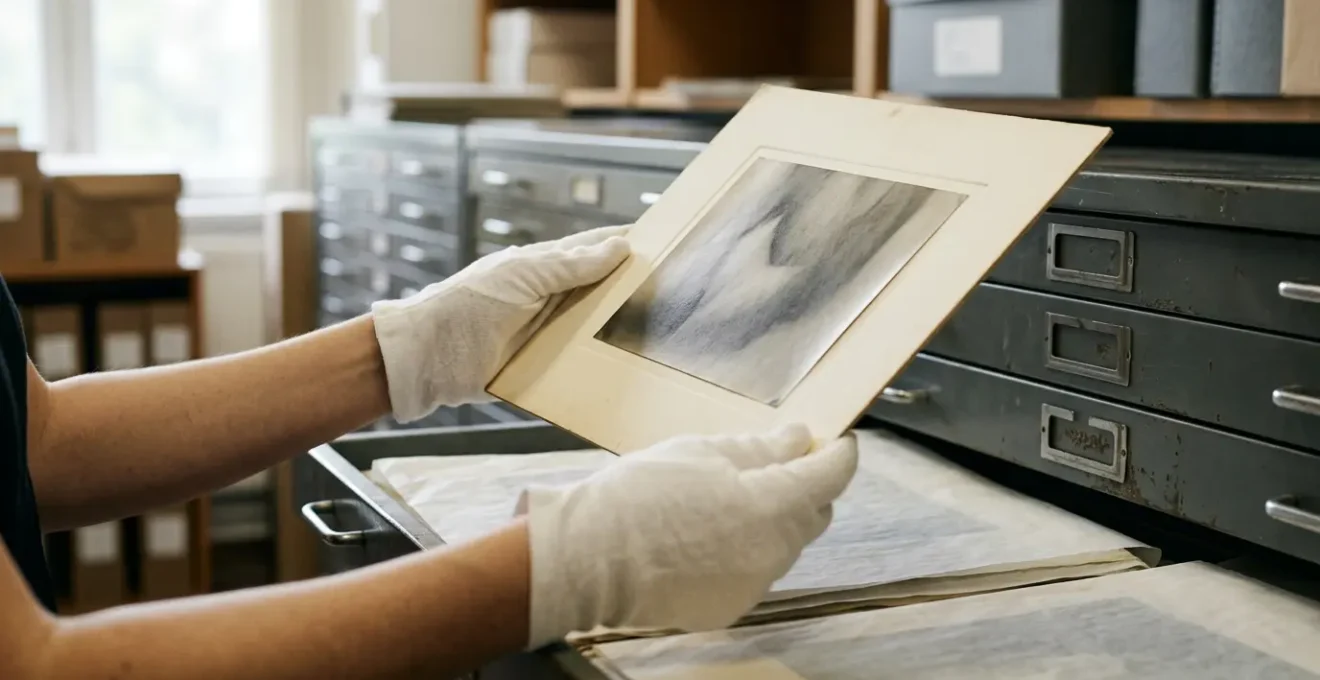
- Handle with Care: Always hold photos by their edges, preferably with clean cotton gloves. Use only a soft pencil on the back border for notations; never use ink, tape, or sticky notes.
- Avoid Self-Restoration: Do not attempt to repair or clean old photographs. You may inadvertently cause irreversible damage, diminishing the work’s historical and financial value.
- Preserve Context: If photos are in an album or a specific sequence, keep them organized that way. This contextual relationship is often a vital part of the collection’s story.
- Contact Curators Early: Initiate conversations with the appropriate curatorial department well in advance. Understand their collection needs, acquisition policies, and donation procedures before making a formal offer.
This strategic preparation transforms a potential gift from a simple donation into a compelling curatorial proposal, ensuring the collection is welcomed and preserved as intended.
Private Foundation or Museum Gift: Which Keeps the Collection Together?
A primary concern for many collectors is ensuring their collection remains intact after their death, preserving their unique curatorial vision. Two primary legal structures exist to achieve this goal: gifting the collection to an existing public charity (like a museum) or establishing a private operating foundation to house and display the works. The choice between these paths has profound, long-term implications for control, cost, and the ultimate stability of the legacy. While a private foundation offers the allure of perpetual control, it comes with significant operational burdens and financial commitments that are often underestimated.
A direct gift to a museum is the most straightforward path. The collector receives a fair market value tax deduction, and the museum assumes all future costs and responsibilities for conservation, insurance, and exhibition. The major trade-off is the complete loss of control. Once the Deed of Gift is signed, the museum’s curators have full discretion over how, when, and if the works are displayed. Critically, they also have the right to deaccession—or sell—works from the collection if they are deemed redundant, outside the museum’s evolving mission, or in poor condition. For a collector whose primary goal is to keep the collection together, this is a significant risk.
A private operating foundation, by contrast, allows the donor and their appointed board to retain complete control. However, this path is exceptionally demanding. It requires substantial initial investment in physical space and a significant endowment to cover perpetual operating costs. As a comparative analysis for financial advisors shows, these foundations have stringent regulatory requirements, including rules about public access and annual spending.
| Criterion | Private Operating Foundation | Museum Gift (Public Charity) |
|---|---|---|
| Control | Donor retains complete control over collection display and use | Museum curators have full control; donor cannot dictate display or retention |
| Tax Deduction (Lifetime) | Full fair market value deduction (same as public charity) | Full fair market value deduction |
| Annual Spending Requirement | Must spend a significant portion of income/assets on direct charitable activities | No mandatory distribution requirement for the gift |
| Public Access Requirement | Must be open to the public with ready access | Museum handles access according to its policies |
| Risk of Deaccessioning | Low – donor controls disposition decisions | Moderate to High – museums regularly deaccession works |
| Long-term Stability | Depends on endowment sustainability and successor board commitment | Typically more stable with professional curatorial mission |
| Initial Setup Cost | High – requires building/space, staff, operational infrastructure | None – museum absorbs all costs |
| Annual Administrative Burden | High – ongoing operations, compliance, staffing | None – museum manages all administration |
Case Study: The Cautionary Tale of the Two Brothers Museum
The operational challenges of a private foundation are starkly illustrated by the story of two brothers who amassed a 1,500-work contemporary art collection. They purchased a historic building in a major U.S. city to found their own museum, earning widespread acclaim. However, they quickly discovered that running a museum was far more complex than building one. After just two and a half years of inconsistent operations and a public dispute with staff, they were forced to close the foundation, demonstrating the immense administrative friction and financial unsustainability that can plague even the most well-intentioned private museum projects.
For most collectors, a carefully negotiated gift to a stable, established institution offers a more realistic path to long-term preservation, even with the compromise on absolute control.
The Estate Mistake of Locking Digital Assets Without Passwords
In the 21st century, a significant portion of a photography collection’s value—its documentation, digital prints, and records of sale—exists purely in digital form. The failure to plan for posthumous access to these assets is one of the most common and devastating estate planning mistakes. Without passwords, PINs, and explicit legal authorization, your heirs and executor may be permanently locked out of essential accounts. This digital lockout can render a physical collection’s provenance untraceable, destroy its value, and make its management or donation impossible. The scale of this problem is vast; digital estate planning research shows the average person has dozens of password-protected accounts, creating a complex web that becomes impenetrable upon death.
Your last will and testament is not the appropriate place to list passwords, as it becomes a public document upon probate. Instead, a separate, comprehensive digital estate plan is required. This document inventories your digital assets—from cloud storage and online gallery accounts to social media and email—and provides clear instructions for their disposition. It must also name a “digital executor,” a designated individual with the technical competence and legal authority to access and manage these accounts. This authority is granted through your will and power of attorney documents, which should explicitly reference the existence and location of your digital estate plan.
Securing this plan is paramount. It can be stored with your attorney, in a safe deposit box, or through a secure digital vault service. The goal is to ensure your executor knows of its existence and how to access it, without exposing sensitive information publicly.
Without this forethought, your meticulously curated collection is at the mercy of technology’s gatekeepers. Providing a key to your digital life is as crucial as providing a key to the vault where your physical prints are stored. It is an essential act of perpetual access planning.
Your Digital Legacy Security Protocol
- Inventory Your Digital Assets: Create a comprehensive list of all digital accounts related to your collection. Include usernames, passwords, account numbers, and answers to security questions.
- Define Your Wishes: For each asset, specify your desired outcome. Designate who should receive access, which accounts should be archived, and which should be deleted.
- Appoint a Digital Executor: Choose a tech-savvy and trustworthy individual to manage your digital assets. This may be a different person than your will’s primary executor. Grant them legal authority through your will.
- Secure the Plan: Store your digital asset inventory in a secure location separate from your will. Options include a password manager with an emergency access feature, a secure physical location, or with your estate attorney.
- Reference, Don’t Reveal: In your main will, include a clause that acknowledges the existence of your separate digital estate plan and specifies its location, without revealing any passwords directly.
Treating your digital estate with the same seriousness as your physical one is no longer optional; it is a fundamental requirement of modern cultural stewardship.
Why Does Non-Archival Mat Board Destroy Your Print in 10 Years?
The physical preservation of a photograph is a science. One of the most insidious and commonly misunderstood threats to a print’s longevity is the material it touches every day: the mat board. Standard, non-archival mat boards are typically made from wood pulp that contains lignin, an acidic polymer. Over time, and accelerated by humidity and temperature changes, this acid migrates from the mat board into the fibers of the photographic paper. This process, known as “acid burn,” results in a characteristic yellow or brown discoloration, embrittlement of the paper, and irreversible damage to the image. A valuable print housed in a standard frame shop mat can be visibly degraded in as little as a decade, and severely damaged over several.
True archival matting, by contrast, is made from 100% cotton rag or purified alpha-cellulose, both of which are naturally acid-free and lignin-free. These materials are chemically inert and will not degrade or release harmful compounds over time. They are often “buffered” with an alkaline substance, such as calcium carbonate, to provide an additional layer of protection by neutralizing any environmental acids that may enter the frame. Choosing archival-grade materials is not a luxury; it is the baseline standard for responsible conservation and a non-negotiable element of ensuring a collection’s physical integrity. Using anything less is an act of managed decline.
However, it is a critical error to believe that archival materials alone are sufficient. As conservation professionals emphasize, preservation is a holistic system. The finest archival mat is rendered ineffective if the framed work is then exposed to harmful environmental conditions.
Archival matting is rendered useless by high humidity, UV light exposure, or temperature fluctuations, promoting a holistic view of conservation.
– Conservation Professionals, Museum Preservation Standards
This holistic view is central to long-term stewardship. The mat board is a critical component, but it works in concert with UV-filtering glazing, proper backing boards, and, most importantly, a stable environment with controlled temperature, humidity, and light levels. A collector must invest in the entire system, not just one isolated part of it.
The choice of mat board is a clear indicator of a collector’s seriousness. It is a small detail that speaks volumes about their commitment to the long-term preservation and future value of their assets.
The Pricing Trap That Suggests a Print Is Fake or Unauthorized
In the art market, a deal that seems “too good to be true” almost always is. An unusually low price for a photograph by a well-known artist should not be seen as a bargain but as a significant red flag. It is often an indicator of one of two critical flaws: the print is an outright forgery, or it is an unauthorized print with a deeply compromised provenance. In either case, acquiring such a piece introduces a fatal weakness into a collection, undermining its overall credibility and value. Experienced collectors and institutions understand that the price of an artwork is inextricably linked to its authenticity and documented history. A steep, unexplainable discount is a signal of high risk.
This is particularly true for photography, where editioning plays a crucial role. An authorized print is part of a limited, numbered edition sanctioned by the artist or their estate. Its value is tied to this scarcity and its documented place within that edition. An “unauthorized” print might be a posthumous reprint, a test print that was supposed to be destroyed, or a print made outside the artist’s control. While it may be a genuine image, it lacks the imprimatur of the artist and has no legitimate place in the market. It is, for all intents and purposes, worthless as a collectible asset.
A collector who knowingly or unknowingly acquires pieces from unverified sources or at suspect prices falls into a “credibility trap.” This decision can cast a shadow over their entire collection, creating complications for future institutional partnerships, estate planning, and tax deductions.
Case Study: Provenance Gaps and the Credibility Trap
The consequences of poor documentation are severe. When authentication becomes an issue due to insufficient paperwork, the historical and financial value of an artwork diminishes. A history of acquiring works from questionable sources creates a “credibility trap” that can taint the provenance of an entire collection. This makes it exceedingly difficult for reputable museums or galleries to engage with the collection, as they cannot take on the risk associated with unverified items. This tarnish complicates everything from securing insurance to obtaining tax deductions for charitable gifts, effectively isolating the collection from the very institutions that could secure its legacy.
Building a collection of cultural significance requires unwavering discipline. It means prioritizing verifiable provenance over perceived bargains and understanding that the integrity of the whole is only as strong as its most questionable part.
Why Hiring an Art Consultant Can Save You Money in the Long Run?
For a high-level collector, the decision to engage an art consultant or advisor is often viewed as an added expense. From a legacy planning perspective, this is a flawed calculation. A qualified advisor is not a broker; they are a strategist whose expertise can prevent costly mistakes, enhance the collection’s long-term value, and, most importantly, shape it into a coherent body of work that is attractive to major institutions. Their fee should be considered a strategic investment in the collection’s cultural capital, which ultimately pays dividends in both financial and philanthropic terms.
An advisor’s primary role is to provide objective, expert guidance insulated from the pressures of a single gallery or auction house. They help a collector define a clear curatorial vision, identifying strengths and weaknesses in the existing collection. This prevents impulsive, emotionally-driven acquisitions that do not align with the collection’s core theme, saving significant capital that might otherwise be spent on incongruous works. They also provide access to their network, opening doors to private sales and artists’ studios that are inaccessible to the general public, often securing more favorable pricing in the process.
Crucially, an advisor with expertise in institutional relations understands what museums are looking for. They guide the collector toward acquiring works that fill gaps in public collections, making the private collection a more compelling candidate for a future gift or acquisition. They ensure that every piece is acquired with impeccable provenance, avoiding the “credibility trap” of questionable works that can devalue an entire holding. As estate planning experts note, this strategic shaping is what transforms a group of pictures into a priceless asset.
The consultant’s fee is a strategic investment in the collection’s coherence and cultural capital, which ultimately makes it a priceless asset for a major institution.
– Estate Planning Experts, Art Collection Strategic Planning
The cost of hiring an advisor is often dwarfed by the cost of a single misstep: acquiring a forgery, overpaying at auction, or purchasing a work with a flawed title. By professionalizing the acquisition process, an advisor mitigates these risks and ensures that capital is deployed effectively to build a collection of lasting cultural and financial worth.
Ultimately, an art consultant’s greatest value is in providing the strategic foresight that elevates a collection from a personal hobby to a targeted, institution-ready cultural legacy.
Key Takeaways
- Documentation is Paramount: A collection’s historical and financial value is underpinned by its provenance. The paper trail is a non-negotiable asset.
- Structure Dictates Control: The choice between a museum gift and a private foundation is a fundamental decision about control versus stability, with significant long-term consequences.
- Preservation is Holistic: Securing a legacy requires protecting both physical prints from environmental threats and digital records from being permanently locked away.
When to Hire an Archivist to Catalog Your Growing Collection?
As a collection grows, it crosses an invisible threshold where its management transitions from a hobbyist’s task to a professional discipline. This is the point at which a collector must consider hiring an archivist. Unlike a curator, who focuses on interpretation and exhibition, an archivist is a specialist in the science of information management, organization, and preservation. Their role is to impose order on complexity and establish the structural foundation that ensures a collection’s long-term research value and institutional integrity. Ignoring this need is a common error that leads to a chaotic and ultimately less valuable holding.
The “tipping point” for hiring an archivist is not a specific number of works, but rather a function of complexity. This point is typically reached when any of the following are true: the collection contains a mix of media (prints, negatives, letters, digital files); the provenance documentation is disorganized or exists in multiple formats; or the sheer volume of items makes it impossible for the collector to retrieve specific information efficiently. When a collection becomes a research archive rather than a simple group of objects, professional intervention is necessary. The archivist transforms a pile of assets into a structured, accessible resource.
The archivist’s primary deliverable is a formal cataloging system and a finding aid. This is the master document—a descriptive inventory and index—that allows researchers, curators, and future estate managers to understand the scope of the collection and locate specific items within it. They will implement a consistent naming convention, digitize physical documents, consolidate provenance records, and ensure all materials are housed in appropriate archival enclosures. They address the difference between a ‘collection’ (a group of items) and an ‘archive’ (an organized body of evidence) by building the intellectual structure that connects them.
Hiring an archivist is not an admission of defeat; it is a strategic investment in the collection’s future usability and a critical step in preparing it for its ultimate destination as a lasting cultural asset.