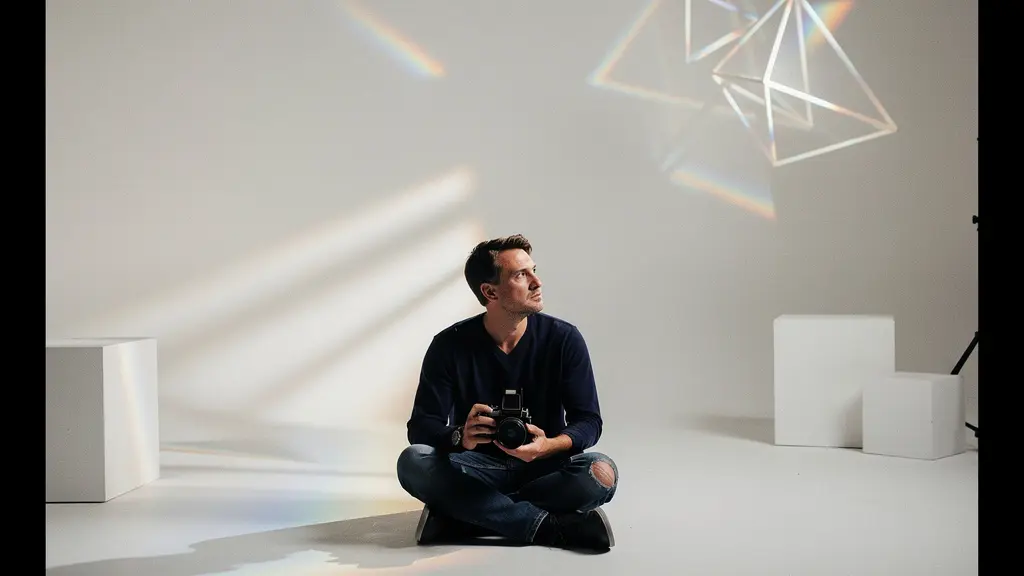
Developing a unique artistic vision is not about finding the right subject or trend, but about learning to translate your inner world into a consistent visual language.
- Mimicking popular aesthetics leads to creative burnout and a forgettable portfolio.
- The biggest barrier to greatness is internal—psychological blocks like perfectionism, not a lack of external inspiration.
Recommendation: Stop looking outward for your style and start an inward excavation to build a visual vernacular that is authentically and undeniably yours.
You feel it, don’t you? The quiet frustration of scrolling through endless feeds, seeing work that is technically proficient but emotionally vacant. You see the popular trends—the desaturated greens, the moody cinematic tones, the perfectly imperfect grain—and you try to replicate them. Yet, your own images feel like echoes of someone else’s voice. For emerging photographers, this feeling of being lost or derivative is a crisis of identity in a market drowning in sameness. The common advice is to “find your niche” or “shoot what you love,” but this guidance falls short. It doesn’t address the core challenge: how to build a vision that is not just different, but deeply and authentically *yours*.
The journey to a powerful artistic vision is rarely about looking outward. It’s an act of internal excavation. What if the key wasn’t in mastering the latest editing style, but in mastering the language of your own emotions? What if your unique perspective, your history, your fears, and your joys were the raw material for a body of work that no one else could create? This is the path of creative sovereignty. It requires moving beyond the surface-level snapshot and challenging the psychological barriers that keep your true voice silent.
For those who prefer a visual summary, the following video offers a complementary look at what it takes to stand out, remastering a classic idea to give it new life.
This guide is structured to walk you through this transformative process. We will deconstruct the traps of imitation, explore the connection between emotion and image, and provide a framework for building and protecting a vision that will define your career. Let’s begin the real work of becoming an artist.
Table of Contents: Forging Your Signature in a World of Copies
- Why Does a Snapshot Fail to Become Fine Art in 99% of Cases?
- Why Does Mimicking Popular Trends Destroy Your Long-Term Career?
- How to Translate Your Inner Emotions into Universal Visual Symbols?
- The Psychological Block That Keeps 70% of Artists from Greatness
- Signature Style or Stagnation: Which Path Are You Actually On?
- How to Filter Critiques to Strengthen Your Vision Without Diluting It?
- Subject Matter or Visual Style: Which Binds a Series Better?
- How to Develop a Strong Curatorial Theme for Your Exhibition?
Why Does a Snapshot Fail to Become Fine Art in 99% of Cases?
In a world where an estimated 93% of all photos are now taken with mobile phones, the line between a casual snapshot and a piece of fine art has become both blurred and critically important. A snapshot is a reaction. It captures a moment, a memory, a piece of information. It says, “I was here.” A work of fine art, however, is an assertion. It doesn’t just record reality; it interprets it. It says, “This is how I see the world.” The fundamental difference is not the camera, the subject, or the technical quality. It’s curatorial intent.
The snapshot is visually passive, relying on the inherent interest of the subject. A child blowing out birthday candles is a compelling snapshot because the moment itself carries the emotional weight. In contrast, fine art photography imbues an ordinary subject with extraordinary meaning through the artist’s deliberate choices. It’s the specific quality of light, the unconventional composition, the carefully chosen color palette—this is the visual vernacular that transforms the mundane into the profound. It is the artist’s visible thought process.
This distinction is what separates hobbyists from career artists. As photography career expert Jill Frank notes, a unique and memorable portfolio is the key differentiator. She explains:
Having an artistic vision and creative drive that makes your portfolio unique and memorable is what sets professionals apart.
– Jill Frank, Photography Career Insights
Therefore, the journey from snapshot-taker to artist begins with a single, powerful shift in mindset: from passively documenting to actively interpreting. Your camera is not a recording device; it is a tool for translation. The question is no longer “What am I looking at?” but “What do I want to say about it?”
Why Does Mimicking Popular Trends Destroy Your Long-Term Career?
Chasing trends is the artistic equivalent of building a house on sand. It offers the illusion of immediate relevance but guarantees long-term instability. When you adopt a popular editing style or shoot subjects that are currently in vogue, you are essentially renting a visual identity. You become a temporary participant in a conversation started by someone else. While this might garner some initial likes and validation, it’s a deeply corrosive practice for any artist serious about a lasting career. The primary danger is the erosion of your creative sovereignty.
The constant pressure to adapt to fleeting algorithmic preferences creates a vicious cycle. You spend your energy learning and replicating instead of discovering and creating. This external focus disconnects you from your own instincts and experiences, which are the only true sources of original work. It’s an exhausting and unsustainable way to create, often leading to a state of creative crisis. This isn’t just a feeling; it’s a documented phenomenon across creative fields. A recent survey revealed that 70% of creative professionals experienced burnout in the last year, a figure fueled by the pressure to perform in a fast-paced, trend-driven environment.
A portfolio built on trends is a portfolio without a foundation. When the trend fades, as all trends do, what remains? Your work becomes dated, indistinguishable from the countless others who rode the same wave. You are left with a collection of images that don’t represent a coherent point of view. A true artistic vision, however, is timeless. It is a consistent thread that runs through your work, evolving and deepening over time, but always rooted in your unique perspective. It is the only asset that appreciates in value throughout your career.
How to Translate Your Inner Emotions into Universal Visual Symbols?
The most powerful art acts as a bridge between the artist’s inner world and the viewer’s experience. But how do you build that bridge? The answer lies in moving beyond literal representation and learning to create visual symbols that carry emotional resonance. This is not about photographing a sad person to convey sadness. It’s about using light, color, shadow, and form to evoke the feeling of sadness itself. It’s the difference between a picture *of* something and a picture *about* something.
This process of translation begins with self-awareness. You must first learn to identify and sit with your own emotional states. What does loneliness *feel* like in your body? Is it the cold, sharp blue of a winter twilight or the heavy, suffocating warmth of an empty room? Is joy a burst of bright, chaotic color or the quiet, steady glow of a single light source? Your personal emotional landscape is your unique palette. The challenge is to distill these complex, personal feelings into a universal visual vernacular—a set of recurring motifs, compositional strategies, or qualities of light that become your signature.
Consider the concept of synesthesia, where one sensory experience triggers another. Great photographers are, in a sense, emotional synesthetes. They see feelings as colors, textures, and shapes. The goal is to develop this skill intentionally. Start a visual journal. Instead of writing about your feelings, try to photograph them. Don’t worry about creating a “good” photo; focus on creating an “honest” one. Does this harsh shadow represent your anxiety? Does this soft, diffused light capture your sense of peace?

This practice slowly builds your vocabulary of emotional symbols. It is, as photographer and educator Alex Kilbee puts it, about learning to see on a deeper level. He writes that photography is “the ability to convey the emotions felt in the presence of the natural world.” Your job is to cultivate that ability, turning abstract feelings into tangible, resonant images that speak a language everyone can understand, even if they don’t know why.
The Psychological Block That Keeps 70% of Artists from Greatness
The greatest obstacle between you and your unique vision is not a lack of talent, time, or equipment. It is the complex web of psychological barriers we erect to protect ourselves from the vulnerability of true creation. This psychological friction—a combination of perfectionism, fear of judgment, and imposter syndrome—is the invisible wall that keeps most artists from producing their most meaningful work. It is the silent killer of creative authenticity.
Perfectionism is perhaps the most insidious of these blocks. It masquerades as a commitment to high standards, but it is actually a manifestation of fear. It’s the fear that your work won’t be good enough, that your inner vision won’t translate perfectly, that you will be judged and found wanting. This fear leads to creative paralysis. You over-plan, you procrastinate, you abandon projects at the first sign of imperfection. According to research on artist burnout, this often manifests in maladaptive behaviors. A study on the topic highlights that strategies like rumination, catastrophizing, and self-blame are hallmarks of this struggle, creating a cycle of anxiety that dries up the creative well.
This internal conflict is often born from a clash between our ideals and the realities of a creative career, a point articulated by researcher Mark Deuze. He observes the dissonance many artists feel:
People enter creative industries with romantic ideals—journalists see themselves as pillars of democracy, artists believe their work is essential to society. But reality rarely matches these ideals.
– Mark Deuze, Well-Being and Creative Careers
Breaking through this wall requires a radical shift. You must reframe your creative practice as a process of exploration, not performance. Give yourself permission to make “bad” art. Create work that is just for you, with no intention of ever showing it to anyone. The goal is to lower the stakes so you can reconnect with the joy of discovery. Your breakthrough will not come from trying harder, but from letting go.
Signature Style or Stagnation: Which Path Are You Actually On?
There is a fine line between a mature, recognizable signature style and a comfortable, stagnant rut. A signature style is a living thing; it’s a coherent visual language that evolves and deepens as you do. Stagnation is a fortress built from past successes; it’s the repetition of a formula because it’s safe and predictable. For the nearly 48% of photographers now working as self-employed professionals, understanding this distinction is a matter of career survival.
So, which path are you on? The key differentiator is risk. Is your work challenging you? Are you exploring the edges of your visual language, or are you staying firmly in the center? A healthy signature style has both consistency and variety. The core elements—your way of seeing light, your compositional tendencies, your thematic concerns—remain, but you apply them to new subjects, new contexts, and new ideas. You push the boundaries of what your style can do. It’s the difference between speaking a language fluently and repeating the same sentence over and over again.
Stagnation often feels comfortable. You’ve found a look that gets positive feedback, so you stick with it. But comfort is the enemy of growth. An artist who is truly in command of their vision is not afraid to experiment, even if it leads to failure. They understand that their vision is not a static “look” but a dynamic point of view. It’s a lens through which they see the world, and that lens can be focused on anything. The question to ask yourself is this: Am I using my style as a tool for exploration, or as a shield against the uncertainty of creating something new?
How to Filter Critiques to Strengthen Your Vision Without Diluting It?
Once you begin to develop a distinct voice, the world will inevitably try to change it. Feedback, whether from mentors, peers, or an online audience, is a double-edged sword. It can provide invaluable insights for growth, or it can dilute your vision until it becomes an unrecognizable composite of other people’s opinions. Learning to filter critique is therefore a crucial survival skill for maintaining your creative sovereignty, especially in an industry where mental health is a significant concern for a vast majority of its members. One staggering study found that as many as 96% of surveyed creative professionals identified a mental health condition, highlighting the immense pressure artists are under.
The first step in building a filter is to consider the source. Not all feedback is created equal. A critique from a seasoned mentor whose work you admire holds more weight than an anonymous comment on social media. A technical suggestion from a peer about your printing process is different from a subjective opinion about your choice of subject matter. You must learn to categorize feedback and assign it the appropriate level of importance. The goal is not to become defensive or dismissive, but to become a discerning listener.
The most effective way to process feedback is to measure it against your own curatorial intent. When someone offers a critique, don’t ask, “Are they right?” Ask, “Does this feedback align with what I was trying to achieve?” If you intended to create a sense of unease and a viewer says the image is “unsettling,” that’s a confirmation, not a criticism. If your goal was clarity and they find the image confusing, that’s valuable data for refinement. Your vision is your anchor. Use it to determine which currents of feedback will move you forward and which will pull you off course.
Your Action Plan: Framework for Processing Creative Feedback
- Categorize Sources: Divide feedback into three tiers: Mentors/Experts (instructional), Peers (diagnostic data), and the General Public (a temperature check of popular reception).
- Distinguish Intent: Separate taste-based opinions (“I don’t like blue”) from objective technical critiques (“The focus is soft”) before deciding how to respond.
- Isolate Variables: Create small, low-stakes experimental projects specifically designed to gather feedback on a single element, like a new lighting technique or color grade.
- Document Patterns: Keep a log of recurring themes in the feedback you receive. A single comment might be an outlier, but a recurring observation points to a genuine area for improvement.
- Set Boundaries: Consciously decide when and how you will receive critiques to protect your creative confidence during vulnerable early stages of a project.
Subject Matter or Visual Style: Which Binds a Series Better?
A common trap for emerging photographers is believing that a cohesive series must be built around a single, consistent subject. They photograph only old barns, or only red flowers, or only people with tattoos. While this can provide an initial structure, it often leads to a body of work that is thematically shallow. A truly powerful and mature series is bound not by *what* is being photographed, but by *how* it is being photographed. The unifying force is the artist’s visual vernacular—their signature style.
When your vision is strong, it becomes the glue that holds disparate subjects together. You can photograph a landscape, a portrait, and a still life, and they will feel like they belong to the same universe because they are all seen through your unique lens. This is the mark of a master. Think of the great photographers; their work is recognizable not because they only shot one thing, but because they shot everything in one way. Their approach to light, composition, and mood is the constant thread.
A compelling case study is the work of photographers like Sally Mann or Todd Hido. Research on building cohesive portfolios highlights how they achieve a recurring theme of ‘stillness’. This is done not by limiting their subjects, but through the consistent use of soft, diffused light and atmospheric conditions. Their style creates the narrative, allowing them to incorporate a wide range of subjects into a singular, resonant body of work. Their vision is the subject.
To test the strength of your own vision, challenge yourself to create a triptych of three completely unrelated subjects. Photograph a building, a person, and a plant. Can you make them feel like they belong together, purely through your stylistic choices? When the answer is yes, you will know you have moved beyond being a photographer of things and have become an artist with a point of view.
Key Takeaways
- A true artistic vision is an internal compass, not an external trend to be followed.
- The greatest barriers to authentic work are psychological (perfectionism, fear) not technical.
- A signature style is a dynamic language that can be applied to any subject, providing coherence beyond thematic repetition.
How to Develop a Strong Curatorial Theme for Your Exhibition?
Developing a curatorial theme is the final and most declarative act in the journey of an artistic vision. Whether it’s for a gallery exhibition, a photobook, or a website portfolio, this is where you crystallize your point of view into a focused, powerful statement. A strong theme is not a simple category like “Landscapes” or “Portraits.” It is a thesis. It’s an argument you are making about the world, with your photographs serving as the evidence. This level of intentional curation is what creates value, a principle evident even in commercial spheres where the demand for curated visual content is rapidly growing.
The process begins with a ruthless edit. You must look at your body of work and identify the central question or obsession that drives it. What is the one idea that connects your best images? Is it an exploration of memory and place? A commentary on human connection in the digital age? A meditation on the passage of time? You must be able to articulate this in a single, compelling sentence. This sentence is your curatorial intent, the North Star for every decision you make.
Once you have your thesis, you become a storyteller. The sequence of your images is the narrative. How does the story begin? Where are the moments of tension and release? How does it conclude? Think about the emotional and intellectual journey you want the viewer to take. Strategic use of negative space—the “breaths” between images—is just as important as the images themselves. Pacing is everything. A great exhibition is not a collection of hits; it’s a symphony where each piece contributes to a greater whole, leaving the viewer with a single, resonant feeling—the feeling of having understood your vision.
Now, the real work begins. The path to a unique artistic vision is not a checklist to be completed but a lifelong practice of self-excavation and translation. Start today by taking one step away from imitation and one step toward authentic expression. Your voice is waiting to be heard.